Friday, May 17, 2013
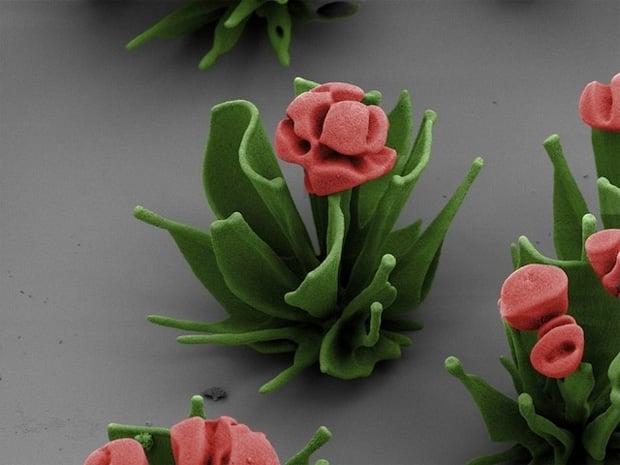
Self Assembly, more beautiful than ever
Look at how we can use our understanding of nanostructures to build microscopic crystal flowers:
http://science.nbcnews.com/_news/2013/05/17/18326298-microscopic-crystal-flowers-build-themselves-in-a-harvard-lab?lite

Thursday, April 4, 2013
Nanotechnology on your device
While there is nanotechnology (i.e. nanosized transistors) in your iPhone and other devices, there are some cool apps that you can download for free that can be used to help describe various aspect of nanotechnology.
A couple are shown here https://itunes.apple.com/us/app/robotics-in-app-nanotechnology/id534160914?mt=8 and are free at the iPhone store.
This is my favorite carbon nanotube app http://www.nanotubeapp.com/ It costs $0.99 but is really amazing.
A couple are shown here https://itunes.apple.com/us/app/robotics-in-app-nanotechnology/id534160914?mt=8 and are free at the iPhone store.
This is my favorite carbon nanotube app http://www.nanotubeapp.com/ It costs $0.99 but is really amazing.
Wednesday, March 20, 2013
Superomniphobicity or how nanopants are affecting the no slip condition
When I was an undergraduate majoring in chemical engineering, my favorite class was fluid dynamics. It was so much more visual and relevant than thermodynamics or a lot of the mass balance-type problem sets that we spent so much time solving. When I thought of fluid dynamics, I thought about scuba diving or tubing down a river. It was easier to understand turbulent and laminar flow when you could close your eyes and think of a riverbed. However, I have just learned that one of the primary assumptions that I made in all those calculations in fluid dynamics – that is the no slip at the wall is, thanks to nanotechnology, being shown to be not so simple. According to Dr. Doug Natelson’s blog Nanoscale Views, developments in surface chemistry have made coatings that are so water repellent that no slip boundary condition a poor assumption in many cases. Back in in the No Slip days was assumed that at the fluid-surface the molecules stuck on the surface and didn’t move, then because of shear stresses and viscosity, a velocity profile would develop that in a cylindrical pipe, would have a maximum in the center of the pipe. Now, however, the latest in surface coatings are Superomniphobic. These coatings are more advanced than the coatings on khaki nanopants, which were designed to repel water and minimize staining. While eliminating the no slip boundary condition will challenge many student’s concepts and calculations in fluid dynamics, it does make for some cool videos (see http://www.popsci.com/science/article/2013-01/video-liquid-bounces-new-superomniphobic-material). For more information on Superomniphobicity please see Dr. Doug Natelson’s blog Nanoscale Views http://nanoscale.blogspot.com/2013/02/superomniphobicity.html.
When I was an undergraduate majoring in chemical engineering, my favorite class was fluid dynamics. It was so much more visual and relevant than thermodynamics or a lot of the mass balance-type problem sets that we spent so much time solving. When I thought of fluid dynamics, I thought about scuba diving or tubing down a river. It was easier to understand turbulent and laminar flow when you could close your eyes and think of a riverbed. However, I have just learned that one of the primary assumptions that I made in all those calculations in fluid dynamics – that is the no slip at the wall is, thanks to nanotechnology, being shown to be not so simple. According to Dr. Doug Natelson’s blog Nanoscale Views, developments in surface chemistry have made coatings that are so water repellent that no slip boundary condition a poor assumption in many cases. Back in in the No Slip days was assumed that at the fluid-surface the molecules stuck on the surface and didn’t move, then because of shear stresses and viscosity, a velocity profile would develop that in a cylindrical pipe, would have a maximum in the center of the pipe. Now, however, the latest in surface coatings are Superomniphobic. These coatings are more advanced than the coatings on khaki nanopants, which were designed to repel water and minimize staining. While eliminating the no slip boundary condition will challenge many student’s concepts and calculations in fluid dynamics, it does make for some cool videos (see http://www.popsci.com/science/article/2013-01/video-liquid-bounces-new-superomniphobic-material). For more information on Superomniphobicity please see Dr. Doug Natelson’s blog Nanoscale Views http://nanoscale.blogspot.com/2013/02/superomniphobicity.html.
Tuesday, May 24, 2011
Not all carbon nanotubes are created equally

The family of carbon nanotubes is large. There can be single walled carbon nanotubes (SWNTs), which are like a rolled up sheet of graphene - a monolayer of carbon bonded into a tubelike structure or they could be multiwalled carbon nanotubes, which have concentric layers of these graphene tubes. These carbon nanotubes can have large aspect ratios (length to width) or could be cut into ultra short carbon nanotubes. In fact, carbon nanotubes come in thousands of different molecular weights and isomers.
One of the most interesting characteristic of Carbon Nanotubes is how dependent the material properties are on small changes in structure. For example, small changes in the way that the carbon atoms align results in the difference between the SWNT being a metal or a semiconductor. This difference in the way the carbons align is called Chirality. Here is an easy way to demonstrate what chirality is. Take a transparency sheet with graphene's structure copied on it and connect two ends to form a cylinder. That is the model of one kind of carbon nanotube with the chiral index of (n, m) where n is the number of carbon atoms across the grid (at the center of each hexagonal structure on your transparency) and m would be zero since you havent moved down the matrix. If you want to make another kind of nanotube, you need to twist the graphene transparency and make a new tube that has a constant diameter. Scientists discovered an odd trend. When (n-m) is divisible by 3 (the product is an integer) then the SWNT is metallic, otherwise it is a semiconductor. Small changes in the arrangement of carbon atoms affects the electronic nature of these materials.
Sunday, November 28, 2010
tectosquares
I am writing this blog as I procrastinate writing the final exam for my BioNano class this fall. During the class, student picked current peer reviewed journal articles and presented them in a short Pecha Kucha format. This means presenting 20 PPT with 20 sec per slide. Topics ranged from applications of gold nanoparticles for lung cancer detection, the effects of feeding Buckyballs to mice, and antimicrobial properties of nanosilver. Students in the class were required to read the papers chosen by their classmates and write up a list of questions (collected for a grade). I thought the format worked out well. Very short presentations followed by fairly animated dialogue (for a 9:30 AM class).
Since the students chose the articles, some were very familiar to me but some were quite unexpected. One of the more interesting topics that I learned about was making tectosquares that are RNA sequences that self assemble into ladder-like nanostructures. In the paper listed below, they used nanogold particles to quantify the spacing. Very Elegant.
Controlled Spacing of Cationic Gold Nanoparticles by Nanocrown RNA
Alexey Y. Koyfman,§,† Gary Braun,§ Sergei Magonov,‡ Arkadiusz Chworos,§ Norbert O. Reich,§,† and Luc Jaeger*,§,† J. AM. CHEM. SOC. 2005, 127, 11886-11887
Since the students chose the articles, some were very familiar to me but some were quite unexpected. One of the more interesting topics that I learned about was making tectosquares that are RNA sequences that self assemble into ladder-like nanostructures. In the paper listed below, they used nanogold particles to quantify the spacing. Very Elegant.
Controlled Spacing of Cationic Gold Nanoparticles by Nanocrown RNA
Alexey Y. Koyfman,§,† Gary Braun,§ Sergei Magonov,‡ Arkadiusz Chworos,§ Norbert O. Reich,§,† and Luc Jaeger*,§,† J. AM. CHEM. SOC. 2005, 127, 11886-11887
Saturday, November 6, 2010
ice and water
The phase transitions between frozen and liquid H2O are so critical to human survivial that we have developed words - Ice and water - To describe these important but not so different events.
Normally phase changes are described by simple subscripts but water is different because it is so vital. How is ice different from liquid water?
Look at these simulations
http://iclcs.illinois.edu/index.php/chemistry-simulations
Normally phase changes are described by simple subscripts but water is different because it is so vital. How is ice different from liquid water?
Look at these simulations
http://iclcs.illinois.edu/index.php/chemistry-simulations
Sunday, October 10, 2010
Why is water so unique?
A year or two ago, I was involved in a debate with some smart people about water. This wasnt a debate over water purity or the future scarceness of water, both of which are important and compelling topics, but something more fundamental. What is water? How are snowflakes formed? What do we call H2O structures? Does it fall under the category of "self assembly"?
One person on this committee didnt think that water fell into the category of nanotechnology, and it lacked the size dependent properties that we use to define nanotechnology. It was deemed too simple and not as compelling as some of the other topics we were thinking about (nanoelectronics, gold nanoshells, quantum dots). However, we don't really understand water and probing the interactions between water molecules is necessary before we can understand complicated structures and biological systems like transport through cell membranes.
However, if we think of the important characteristics of water like hydrogen bonding, solvation, and how it serves as the basis of life (along with some carbon and nitrogen), then we must realize that understanding the chemistry of water is essential to understanding the future of science. Research on water is not a trivial exploration and this study exemplifies some of the complexity of the substance we take for granted http://pubs.acs.org/doi/abs/10.1021%2Fjp1060792
One person on this committee didnt think that water fell into the category of nanotechnology, and it lacked the size dependent properties that we use to define nanotechnology. It was deemed too simple and not as compelling as some of the other topics we were thinking about (nanoelectronics, gold nanoshells, quantum dots). However, we don't really understand water and probing the interactions between water molecules is necessary before we can understand complicated structures and biological systems like transport through cell membranes.
However, if we think of the important characteristics of water like hydrogen bonding, solvation, and how it serves as the basis of life (along with some carbon and nitrogen), then we must realize that understanding the chemistry of water is essential to understanding the future of science. Research on water is not a trivial exploration and this study exemplifies some of the complexity of the substance we take for granted http://pubs.acs.org/doi/abs/10.1021%2Fjp1060792
Subscribe to:
Posts (Atom)