Friday, May 17, 2013
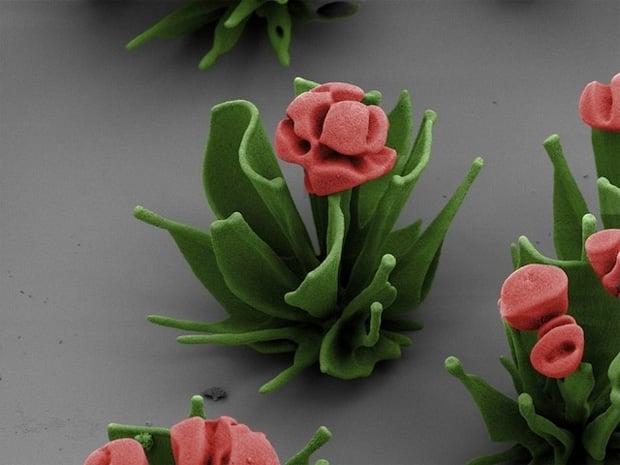
Self Assembly, more beautiful than ever
Look at how we can use our understanding of nanostructures to build microscopic crystal flowers:
 http://science.nbcnews.com/_news/2013/05/17/18326298-microscopic-crystal-flowers-build-themselves-in-a-harvard-lab?lite

Thursday, April 4, 2013
Nanotechnology on your device
While there is nanotechnology (i.e. nanosized transistors) in your iPhone and other devices, there are some cool apps that you can download for free that can be used to help describe various aspect of nanotechnology.
A couple are shown here https://itunes.apple.com/us/app/robotics-in-app-nanotechnology/id534160914?mt=8 and are free at the iPhone store.
This is my favorite carbon nanotube app http://www.nanotubeapp.com/ It costs $0.99 but is really amazing.
A couple are shown here https://itunes.apple.com/us/app/robotics-in-app-nanotechnology/id534160914?mt=8 and are free at the iPhone store.
This is my favorite carbon nanotube app http://www.nanotubeapp.com/ It costs $0.99 but is really amazing.
Wednesday, March 20, 2013
Superomniphobicity or how nanopants are affecting the no slip condition
When I was an undergraduate majoring in chemical engineering, my favorite class was fluid dynamics. It was so much more visual and relevant than thermodynamics or a lot of the mass balance-type problem sets that we spent so much time solving. When I thought of fluid dynamics, I thought about scuba diving or tubing down a river. It was easier to understand turbulent and laminar flow when you could close your eyes and think of a riverbed. However, I have just learned that one of the primary assumptions that I made in all those calculations in fluid dynamics – that is the no slip at the wall is, thanks to nanotechnology, being shown to be not so simple. According to Dr. Doug Natelson’s blog Nanoscale Views, developments in surface chemistry have made coatings that are so water repellent that no slip boundary condition a poor assumption in many cases. Back in in the No Slip days was assumed that at the fluid-surface the molecules stuck on the surface and didn’t move, then because of shear stresses and viscosity, a velocity profile would develop that in a cylindrical pipe, would have a maximum in the center of the pipe. Now, however, the latest in surface coatings are Superomniphobic. These coatings are more advanced than the coatings on khaki nanopants, which were designed to repel water and minimize staining. While eliminating the no slip boundary condition will challenge many student’s concepts and calculations in fluid dynamics, it does make for some cool videos (see http://www.popsci.com/science/article/2013-01/video-liquid-bounces-new-superomniphobic-material). For more information on Superomniphobicity please see Dr. Doug Natelson’s blog Nanoscale Views http://nanoscale.blogspot.com/2013/02/superomniphobicity.html.
When I was an undergraduate majoring in chemical engineering, my favorite class was fluid dynamics. It was so much more visual and relevant than thermodynamics or a lot of the mass balance-type problem sets that we spent so much time solving. When I thought of fluid dynamics, I thought about scuba diving or tubing down a river. It was easier to understand turbulent and laminar flow when you could close your eyes and think of a riverbed. However, I have just learned that one of the primary assumptions that I made in all those calculations in fluid dynamics – that is the no slip at the wall is, thanks to nanotechnology, being shown to be not so simple. According to Dr. Doug Natelson’s blog Nanoscale Views, developments in surface chemistry have made coatings that are so water repellent that no slip boundary condition a poor assumption in many cases. Back in in the No Slip days was assumed that at the fluid-surface the molecules stuck on the surface and didn’t move, then because of shear stresses and viscosity, a velocity profile would develop that in a cylindrical pipe, would have a maximum in the center of the pipe. Now, however, the latest in surface coatings are Superomniphobic. These coatings are more advanced than the coatings on khaki nanopants, which were designed to repel water and minimize staining. While eliminating the no slip boundary condition will challenge many student’s concepts and calculations in fluid dynamics, it does make for some cool videos (see http://www.popsci.com/science/article/2013-01/video-liquid-bounces-new-superomniphobic-material). For more information on Superomniphobicity please see Dr. Doug Natelson’s blog Nanoscale Views http://nanoscale.blogspot.com/2013/02/superomniphobicity.html.
Tuesday, May 24, 2011
Not all carbon nanotubes are created equally

The family of carbon nanotubes is large. There can be single walled carbon nanotubes (SWNTs), which are like a rolled up sheet of graphene - a monolayer of carbon bonded into a tubelike structure or they could be multiwalled carbon nanotubes, which have concentric layers of these graphene tubes. These carbon nanotubes can have large aspect ratios (length to width) or could be cut into ultra short carbon nanotubes. In fact, carbon nanotubes come in thousands of different molecular weights and isomers.
One of the most interesting characteristic of Carbon Nanotubes is how dependent the material properties are on small changes in structure. For example, small changes in the way that the carbon atoms align results in the difference between the SWNT being a metal or a semiconductor. This difference in the way the carbons align is called Chirality. Here is an easy way to demonstrate what chirality is. Take a transparency sheet with graphene's structure copied on it and connect two ends to form a cylinder. That is the model of one kind of carbon nanotube with the chiral index of (n, m) where n is the number of carbon atoms across the grid (at the center of each hexagonal structure on your transparency) and m would be zero since you havent moved down the matrix. If you want to make another kind of nanotube, you need to twist the graphene transparency and make a new tube that has a constant diameter. Scientists discovered an odd trend. When (n-m) is divisible by 3 (the product is an integer) then the SWNT is metallic, otherwise it is a semiconductor. Small changes in the arrangement of carbon atoms affects the electronic nature of these materials.
Sunday, November 28, 2010
tectosquares
I am writing this blog as I procrastinate writing the final exam for my BioNano class this fall. During the class, student picked current peer reviewed journal articles and presented them in a short Pecha Kucha format. This means presenting 20 PPT with 20 sec per slide. Topics ranged from applications of gold nanoparticles for lung cancer detection, the effects of feeding Buckyballs to mice, and antimicrobial properties of nanosilver. Students in the class were required to read the papers chosen by their classmates and write up a list of questions (collected for a grade). I thought the format worked out well. Very short presentations followed by fairly animated dialogue (for a 9:30 AM class).
Since the students chose the articles, some were very familiar to me but some were quite unexpected. One of the more interesting topics that I learned about was making tectosquares that are RNA sequences that self assemble into ladder-like nanostructures. In the paper listed below, they used nanogold particles to quantify the spacing. Very Elegant.
Controlled Spacing of Cationic Gold Nanoparticles by Nanocrown RNA
Alexey Y. Koyfman,§,† Gary Braun,§ Sergei Magonov,‡ Arkadiusz Chworos,§ Norbert O. Reich,§,† and Luc Jaeger*,§,† J. AM. CHEM. SOC. 2005, 127, 11886-11887
Since the students chose the articles, some were very familiar to me but some were quite unexpected. One of the more interesting topics that I learned about was making tectosquares that are RNA sequences that self assemble into ladder-like nanostructures. In the paper listed below, they used nanogold particles to quantify the spacing. Very Elegant.
Controlled Spacing of Cationic Gold Nanoparticles by Nanocrown RNA
Alexey Y. Koyfman,§,† Gary Braun,§ Sergei Magonov,‡ Arkadiusz Chworos,§ Norbert O. Reich,§,† and Luc Jaeger*,§,† J. AM. CHEM. SOC. 2005, 127, 11886-11887
Saturday, November 6, 2010
ice and water
The phase transitions between frozen and liquid H2O are so critical to human survivial that we have developed words - Ice and water - To describe these important but not so different events.
Normally phase changes are described by simple subscripts but water is different because it is so vital. How is ice different from liquid water?
Look at these simulations
http://iclcs.illinois.edu/index.php/chemistry-simulations
Normally phase changes are described by simple subscripts but water is different because it is so vital. How is ice different from liquid water?
Look at these simulations
http://iclcs.illinois.edu/index.php/chemistry-simulations
Sunday, October 10, 2010
Why is water so unique?
A year or two ago, I was involved in a debate with some smart people about water. This wasnt a debate over water purity or the future scarceness of water, both of which are important and compelling topics, but something more fundamental. What is water? How are snowflakes formed? What do we call H2O structures? Does it fall under the category of "self assembly"?
One person on this committee didnt think that water fell into the category of nanotechnology, and it lacked the size dependent properties that we use to define nanotechnology. It was deemed too simple and not as compelling as some of the other topics we were thinking about (nanoelectronics, gold nanoshells, quantum dots). However, we don't really understand water and probing the interactions between water molecules is necessary before we can understand complicated structures and biological systems like transport through cell membranes.
However, if we think of the important characteristics of water like hydrogen bonding, solvation, and how it serves as the basis of life (along with some carbon and nitrogen), then we must realize that understanding the chemistry of water is essential to understanding the future of science. Research on water is not a trivial exploration and this study exemplifies some of the complexity of the substance we take for granted http://pubs.acs.org/doi/abs/10.1021%2Fjp1060792
One person on this committee didnt think that water fell into the category of nanotechnology, and it lacked the size dependent properties that we use to define nanotechnology. It was deemed too simple and not as compelling as some of the other topics we were thinking about (nanoelectronics, gold nanoshells, quantum dots). However, we don't really understand water and probing the interactions between water molecules is necessary before we can understand complicated structures and biological systems like transport through cell membranes.
However, if we think of the important characteristics of water like hydrogen bonding, solvation, and how it serves as the basis of life (along with some carbon and nitrogen), then we must realize that understanding the chemistry of water is essential to understanding the future of science. Research on water is not a trivial exploration and this study exemplifies some of the complexity of the substance we take for granted http://pubs.acs.org/doi/abs/10.1021%2Fjp1060792
Tuesday, July 13, 2010
proton size?
I woke up this morning feeling maybe smaller, maybe less energized. In fact, a new study in Nature calculates that the proton is 4% smaller than previously thought or as this Scientific American headline reads "proton shrinks in size" http://www.scientificamerican.com/article.cfm?id=proton-shrinks-in-size. So perhaps my jeans really do fit better today because my protons are smaller than they were last week.
What do these studies imply? Does this mean that we don't understand the basic structure of the atom as well as we thought? Does a 4% difference matter? Perhaps there was a calculation error and this newest technology that was used in this experiment is just off somewhat. Since now the Rydberg constant would now be different, does this through a glitch into the whole concept of quantum theory? Should we care? While protons are measured in femtometers are a lot smaller than nanometers (1,000,000times), all matter is composed of protons, electrons and neutrons. So when someone says your protons are smaller than they thought, you should take note.
What do these studies imply? Does this mean that we don't understand the basic structure of the atom as well as we thought? Does a 4% difference matter? Perhaps there was a calculation error and this newest technology that was used in this experiment is just off somewhat. Since now the Rydberg constant would now be different, does this through a glitch into the whole concept of quantum theory? Should we care? While protons are measured in femtometers are a lot smaller than nanometers (1,000,000times), all matter is composed of protons, electrons and neutrons. So when someone says your protons are smaller than they thought, you should take note.
Sunday, June 20, 2010
Opportunity to share your ideas about nanotech with the Office of the President
President's Council of Advisors on Science and Technology(PCAST) will be hosting a webcast on nano, bio and information technology. If you go to the OpenPCAST website, http://pcast.ideascale.com/ and submit your ideas. The webcast will be on Tuesday, June 22 from 10 am to 2:30 pm. See the PCAST site for more details. http://www.whitehouse.gov/blog/2010/06/15/polishing-technology-s-golden-triangle
Thursday, June 10, 2010
Nanocomposites and everyday things
I just put some Saran wrap on leftovers. Was it Saran or some cheaper knock off? Does it matter? Probably not, since my family will eat it tomorrow regardless (they are not picky). However, if you were packing a product to be shipped around the world, like an expensive pharmaceutical product or even an inexpensive snack, you would care. Time is money - esp. when it is sitting on a store shelf.
How does this relate to the esoteric term, nanocomposites? The cause of most food spoilage is are either microbial or chemical- specifically oxidation. Microbes are relatively large (micron sized), so plastic films easily act as a barrier. A molecule of oxygen, however, is very small (more than 1000 times smaller than a microbe) and can be transported through plastics (also known as polymers) easily. This transport or permeability depends on the solubility of oxygen (or how well it dissolves) in the polymer and its ability to diffuse or move through the polymer.
Different polymers have vastly different gas transport properties and cheap polyethylene (Glad wrap) is much more permeable to gases than polyvinylidene chloride (Saran wrap). However, if you look at the packaging after you finish those chips from the vending machine, you will see that they have an additional layer of aluminum foil that really prevents gas transport.
Recently it has been found that when polymers are sequentially prepared into nanometer thick layer cakes, the barrier properties of the materials improve. Because polymers are glass-like structures, they tend to change or relax over time. This relaxation basically allows the polymer molecules to get closer together and this more compact structure blocks the transport of gas through the material. So controlling the nanostructure of polymer films could increase the shelf life of products and potentially eliminate the need for the expensive aluminum layer in packaging.
More specifically, a composite in a combination of materials. A polymer with nanosized additives would be called a nanocomposite. Adding nanosized particles to polymers can increase its strength, decrease its weight and improve its barrier properties (or how well it blocks oxygen). The nanosized material could be relatively inert clay materials or potentially antioxidant or antimicrobial particles.
While many people think of packaging as either something for marketing or something that is waste issue, and indeed both are true, good packaging prevents food spoilage and protects the activity of pharmaceutical products. Every day we pack a lunch, save leftovers, open a container from the store. Whether we like it or not, packaging is a part of our everyday lives.
How does this relate to the esoteric term, nanocomposites? The cause of most food spoilage is are either microbial or chemical- specifically oxidation. Microbes are relatively large (micron sized), so plastic films easily act as a barrier. A molecule of oxygen, however, is very small (more than 1000 times smaller than a microbe) and can be transported through plastics (also known as polymers) easily. This transport or permeability depends on the solubility of oxygen (or how well it dissolves) in the polymer and its ability to diffuse or move through the polymer.
Different polymers have vastly different gas transport properties and cheap polyethylene (Glad wrap) is much more permeable to gases than polyvinylidene chloride (Saran wrap). However, if you look at the packaging after you finish those chips from the vending machine, you will see that they have an additional layer of aluminum foil that really prevents gas transport.
Recently it has been found that when polymers are sequentially prepared into nanometer thick layer cakes, the barrier properties of the materials improve. Because polymers are glass-like structures, they tend to change or relax over time. This relaxation basically allows the polymer molecules to get closer together and this more compact structure blocks the transport of gas through the material. So controlling the nanostructure of polymer films could increase the shelf life of products and potentially eliminate the need for the expensive aluminum layer in packaging.
More specifically, a composite in a combination of materials. A polymer with nanosized additives would be called a nanocomposite. Adding nanosized particles to polymers can increase its strength, decrease its weight and improve its barrier properties (or how well it blocks oxygen). The nanosized material could be relatively inert clay materials or potentially antioxidant or antimicrobial particles.
While many people think of packaging as either something for marketing or something that is waste issue, and indeed both are true, good packaging prevents food spoilage and protects the activity of pharmaceutical products. Every day we pack a lunch, save leftovers, open a container from the store. Whether we like it or not, packaging is a part of our everyday lives.
Tuesday, May 4, 2010
Nanotechnology lectures freely available from CHEM 570 Nanotechnology for Teachers
Dr. John Hutchinson and I taught Nanotechnology for Teachers out of Rice University and The University of Colorado at Boulder in the Spring of 2009 using distance learning software. All of the course content, including cutting edge research presentations from Rice Faculty, Post-Docs and Graduate students are freely available at http://webcast.rice.edu/webcast.php?action=details&event=1724
Sunday, March 14, 2010
Fun Nano labs
Synthesizing ferrofluids and liquid crystals are laboratory activities that can be conducted in a 75 minute lab. At Rice University we have incorporated these labs in our freshmen chemistry course and have taught it to teachers in our Nanotechnology for Teachers course. An outline of the protocol is described by Dr. Mary McHale at http://cnx.org/content/m15768/latest/
Monday, March 8, 2010
Stellar Nanotubes
In 2008, carbon nanostructures that looked like long carbon nanotubes were
identified in three meteorites. This was surprising because on earth, the temperatures and pressures associated with making carbon fullerene structures were/are very energy intensive and involve very toxic and/or expensive catalysts. However, scientists are now looking at ways to mimic interstellar reactions to create carbon fullerine structures. http://www.sciencedaily.com/releases/2010/02/100224214434.htm
Which is appropriate because the first carbon fullerene structures that were identified by Kroto, Curl and Smalley at Rice University, were bucky balls or soccerball shaped structures of carbon. The discovery of the buckyball came out of investigations of carbon structures in interstellar space.
identified in three meteorites. This was surprising because on earth, the temperatures and pressures associated with making carbon fullerene structures were/are very energy intensive and involve very toxic and/or expensive catalysts. However, scientists are now looking at ways to mimic interstellar reactions to create carbon fullerine structures. http://www.sciencedaily.com/releases/2010/02/100224214434.htm
Which is appropriate because the first carbon fullerene structures that were identified by Kroto, Curl and Smalley at Rice University, were bucky balls or soccerball shaped structures of carbon. The discovery of the buckyball came out of investigations of carbon structures in interstellar space.
Thursday, November 19, 2009
what is in your kitty litter

Diatomaceous earth is a common material that we buy in bulk and put into our pool filters and kitty litter. If you thought it was just dirt take a close look. We are mining fossils; an antique algae that looks like a nanomachine.
Friday, November 6, 2009
Nanocars and such
I was asked at dinner tonight about Dr Jim Tour's work on Nanocars by a nonscientist. What I said is that Jim Tour's research on nanocars really highlights how creative minds can envision chemical structures, synthesize them, and then see them in real time because of recent advances in nanotechnology. Dr. Tour takes organic chemistry and makes it interesting by using analogies between nanoscopic molecules and macroscopic things we can see in our everyday life. Nanocars are molecules that have flexible bonds between ring-like structures that can rotate like wheels on a car. Dr. Tour has tested these molecules on various surfaces and used imaging modalities like atomic force microscopy to prove that these molecules do in fact have wheel-like structures that rotate like car tires (he has also synthesized nanoworms or molecules that simply slide across surfaces). What needs to be clarified is that there is not a driver of Dr. Tour's nanocars. These are not nanobots that can be programmed to do a specific function nor can they replicate or be controlled by an outside forces. These nanocars are simply organic molecules that respond to forces like heat and friction to change their conformations (ie. rotate or move) just like any other molecule in the world. It is just that they are synthesized to look like cars and can move across surfaces like roads however they are driven by random thermal energetic forces. They are quite pretty and have an unique ability to engage people in science but just remember, they are molecules that react to physical forces, not magic, not science fiction.
Monday, October 26, 2009
Gold Nanoshells
Why are gold nanoshells for cancer treatment so interesting?
Gold nanoshells are 90- 130 nm particles of silica coated with a thin layer of gold that have unusual optical feature and can potentially be used for cancer therapy and diagnosis. The thin gold coating on the glassy substrate results in a product that can be designed to absorb and scatter light at very specific frequencies. This "tunable" property means by changing the ratio of the silica core to the gold ,gold nanoshells can be manufactured to respond to near infrared light frequencies (>800nm) that are very desirable for therapy and disease detection because near infrared light can pass through human tissue relatively easily.
We have chromophores in our body, like hemoglobin, that like to absorb light in the visible region of the electromagnetic spectrum. So if we can design particles that absorb at the near infrared spectrum (slightly outside of the visible spectra) then these light waves can travel through our tissues without interference from our chemicals that are naturally present in our bodies.
How do nanoshells kill cancer cells?
Called photoablation therapy, this process works because when specific frequency of light is directed at nanoshells, they heat up and the tissue where the nanoshells are located is destroyed via heat. The nanoshells collect around tumors because the blood vessels that are formed to feed the fast growing cancer cells are very abnormal and have a leaky characteristic that let nanoparticles somewhat selectively stay in the the cancerous area.
Because of the surface phenomena that is inherent in metal nanoparticles, gold nanoshells respond to an incident light beam and heat up.
Why do nanoshells heat up?
There are electrons on the surfaces of metals that are free to move around. Because nanoparticles have a lot more surface area exposed than larger particles, the phenomena that occurs at the surface plays a much larger role in determining the physics of the system than if you had a large, bulk chunk of metal. In nanogold, the electrons on the surface of the metal particle can respond to incident light. They basically can vibrate or resonate in frequency with the color of the the light. This is analogous to a child being pushed on a swing. Just like there is an inherent frequency to the push on the swing that will keep the child in motion, light waves can induce a frequency response in the electron on the surface of a metal. This cloud of electrons, often called a plasmon, can swish back and forth across the nanoparticle in response to the incident light. Some of the light energy is transferred in heat and so the particles heat up at specific frequencies. This heat is what kills the cancer cells.
Gold nanoshells are 90- 130 nm particles of silica coated with a thin layer of gold that have unusual optical feature and can potentially be used for cancer therapy and diagnosis. The thin gold coating on the glassy substrate results in a product that can be designed to absorb and scatter light at very specific frequencies. This "tunable" property means by changing the ratio of the silica core to the gold ,gold nanoshells can be manufactured to respond to near infrared light frequencies (>800nm) that are very desirable for therapy and disease detection because near infrared light can pass through human tissue relatively easily.
We have chromophores in our body, like hemoglobin, that like to absorb light in the visible region of the electromagnetic spectrum. So if we can design particles that absorb at the near infrared spectrum (slightly outside of the visible spectra) then these light waves can travel through our tissues without interference from our chemicals that are naturally present in our bodies.
How do nanoshells kill cancer cells?
Called photoablation therapy, this process works because when specific frequency of light is directed at nanoshells, they heat up and the tissue where the nanoshells are located is destroyed via heat. The nanoshells collect around tumors because the blood vessels that are formed to feed the fast growing cancer cells are very abnormal and have a leaky characteristic that let nanoparticles somewhat selectively stay in the the cancerous area.
Because of the surface phenomena that is inherent in metal nanoparticles, gold nanoshells respond to an incident light beam and heat up.
Why do nanoshells heat up?
There are electrons on the surfaces of metals that are free to move around. Because nanoparticles have a lot more surface area exposed than larger particles, the phenomena that occurs at the surface plays a much larger role in determining the physics of the system than if you had a large, bulk chunk of metal. In nanogold, the electrons on the surface of the metal particle can respond to incident light. They basically can vibrate or resonate in frequency with the color of the the light. This is analogous to a child being pushed on a swing. Just like there is an inherent frequency to the push on the swing that will keep the child in motion, light waves can induce a frequency response in the electron on the surface of a metal. This cloud of electrons, often called a plasmon, can swish back and forth across the nanoparticle in response to the incident light. Some of the light energy is transferred in heat and so the particles heat up at specific frequencies. This heat is what kills the cancer cells.
Tuesday, May 12, 2009
NIH challenge grant rabbit-hole
I have not written a blog lately because the NIH released a Science Technology Engineering and Math (STEM) challenge grant 12-OD-102 that was equivalent to saying Drink Me. And then another (12-OD-101) that said Eat Me. The first was to develop a high impact professional development program for science teachers; the other was to show that there was a more effective way for students to learn science. Once someone really smart told me if there seems like there should be a better way, there probably is. Certainly we know a lot about how people learn, yet we aren't teaching that way. This is how I wound up writing two challenge grants, or at least working on them on my spare time.
Released on March 4, 2009,and due on April 27, 2009, the NIH RFA OD-09-003 had a compelling white rabbit to follow: Come up with a unique solution to an important health or education problem that could be tested in a two year period at a price tag of $500,000/year. The challenge areas ranged from bioethics to translational medicine, with this outreach and education solicitation in the middle of the pack.
For those of you who haven't had the opportunity to write an NIH grant lately (it had been a decade for me), this rabbit takes some curious turns (pools of tears, caterpillar advice, etc). Learning that the background section is not allowed, Time 12 font is illegal, and that using the NSF biosketch format could cause your grant to be rejected are just some of the treats at this tea party. Luckily, our university hired extra excellent staff to help us learn how to play croquet with the queen. So now our grant has been submitted and we occasionally get emails that it has passed through another threshold on its journey to be reviewed.
I am not complaining about the experience because we came up with two good ideas that I hope some agency will eventually fund. I am just trying to justify my absence from my blog. I also hope that the reviewers of our grant like the opening: Twas brillig
Released on March 4, 2009,and due on April 27, 2009, the NIH RFA OD-09-003 had a compelling white rabbit to follow: Come up with a unique solution to an important health or education problem that could be tested in a two year period at a price tag of $500,000/year. The challenge areas ranged from bioethics to translational medicine, with this outreach and education solicitation in the middle of the pack.
For those of you who haven't had the opportunity to write an NIH grant lately (it had been a decade for me), this rabbit takes some curious turns (pools of tears, caterpillar advice, etc). Learning that the background section is not allowed, Time 12 font is illegal, and that using the NSF biosketch format could cause your grant to be rejected are just some of the treats at this tea party. Luckily, our university hired extra excellent staff to help us learn how to play croquet with the queen. So now our grant has been submitted and we occasionally get emails that it has passed through another threshold on its journey to be reviewed.
I am not complaining about the experience because we came up with two good ideas that I hope some agency will eventually fund. I am just trying to justify my absence from my blog. I also hope that the reviewers of our grant like the opening: Twas brillig
Tuesday, March 24, 2009
ACS annual meeting Nanoscience: Challenges for the Future
As I pack up to leave Salt Lake City and the 237th American Chemical Society meeting, I wanted to reflect on some of the comments about the future of nanotechnology and nanoeducation.
From the education sessions, it seems clear that K-12 teachers are taking bits and pieces of activities that have been developed through NNI funding. It has to "fit" into their curriculum and that means that it is only adapted if the teachers find it easy to use and it supports and augments the content they are required to teach. For example, 3 week modules on a topic on nanotechnology are unlikely to be used as designed and assessed. The school systems are not flexible enough to allow teachers to implement new curriculum and the testing schedules make it almost impossible for teachers to devote large chunks of time to new content.
The general consensus that I witnessed about undergraduate majors in nanotechnology was that they are too general and students would be better served by majoring on a core science or engineering and then doing nanoscience research in postgraduate studies. There was concern that the true interdisplinary strength of nanoscience research will be watered down if we don't have students with strong foundations in basic sciences. They need to approach nano-projects from different viewpoints. Nanotechnology minors might have more support. Especially if it encourages students to explore a series of courses where they get hands on exposure to some of the tools that are used in nanoscience research but may not be available to undergraduates.
Whitesides commented that nanotechnology as a field is maturing. We have passed beyond the hype and unreasonable expectations of the late 90's and have passed through the following disappointment stage of this decade and are now ready for steady growth - as long as we understand structure-property functions and create materials that have real applications.
From the education sessions, it seems clear that K-12 teachers are taking bits and pieces of activities that have been developed through NNI funding. It has to "fit" into their curriculum and that means that it is only adapted if the teachers find it easy to use and it supports and augments the content they are required to teach. For example, 3 week modules on a topic on nanotechnology are unlikely to be used as designed and assessed. The school systems are not flexible enough to allow teachers to implement new curriculum and the testing schedules make it almost impossible for teachers to devote large chunks of time to new content.
The general consensus that I witnessed about undergraduate majors in nanotechnology was that they are too general and students would be better served by majoring on a core science or engineering and then doing nanoscience research in postgraduate studies. There was concern that the true interdisplinary strength of nanoscience research will be watered down if we don't have students with strong foundations in basic sciences. They need to approach nano-projects from different viewpoints. Nanotechnology minors might have more support. Especially if it encourages students to explore a series of courses where they get hands on exposure to some of the tools that are used in nanoscience research but may not be available to undergraduates.
Whitesides commented that nanotechnology as a field is maturing. We have passed beyond the hype and unreasonable expectations of the late 90's and have passed through the following disappointment stage of this decade and are now ready for steady growth - as long as we understand structure-property functions and create materials that have real applications.
Sunday, March 15, 2009
science fair blues
On Friday, I judged 14 chemistry projects at the Houston district science fair. This is a big deal. This was the 50th anniversary of Science and Engineering Fair of Houston. It is a big deal for a student to make it to the judging at the Houston convention center. Advancement to this division means that their project that was one of 30,000 projects entered in the preliminary school/district fair competitions that was chosen to be in this elite group of 1,300 projects from 140 schools. I remember when my daughter's science fair project progressed from from her class science fair, from her school, from her school's region to this large venue - a two day extravaganza.
However, as a judge for over a decade, I can honestly say that the science fair projects, at this level, have never been as dismal as it was on Friday. This was agreed upon by all of the judges in my group. Is it our No Child Left Behind Policy? Is it because the number of students in the Houston Independent School District (HISD) is decreasing while the population of Houston is growing? Are these new students choosing to attend schools outside of HISD? Because of our high stakes testing, I believe that teachers have less class time to devote to science fair projects.
What teachers need to understand is that science fair projects, the posters, and discussions about them, are real. This is really how scientists work. We have poster sessions at meetings where we show our data and defend our findings, seek advice and make connections. Science fair really matters.
However, as a judge for over a decade, I can honestly say that the science fair projects, at this level, have never been as dismal as it was on Friday. This was agreed upon by all of the judges in my group. Is it our No Child Left Behind Policy? Is it because the number of students in the Houston Independent School District (HISD) is decreasing while the population of Houston is growing? Are these new students choosing to attend schools outside of HISD? Because of our high stakes testing, I believe that teachers have less class time to devote to science fair projects.
What teachers need to understand is that science fair projects, the posters, and discussions about them, are real. This is really how scientists work. We have poster sessions at meetings where we show our data and defend our findings, seek advice and make connections. Science fair really matters.
Saturday, March 7, 2009
health care
This is outside my normal post, but I think that Health Care is important enough and personal enough to break through ideological constraints. Especially if I think I have something to contribute to the dialogue. Having been pregnant in Austin Texas and delivering a baby there (I drove myself to the hospital) and 2years later, having a baby in Stavanger Norway, I think that it is important that people understand what our idea of "free market" health care has wrought, at least in comparison to one of the most socialized systems in Europe. Our free market approach has created a market for competition in the the most exclusive realms of our health care system. It makes no sense from either an economic or sociological point of view. There are hospitals compteteing to the the most exclusive, up-to-date maternity wards for those few patients who have the luxury of a full American insurance plan.
Meanwhile, the rest of the country is suffering in ignorance and neglect. Strikingly,there are very few prenatal care options for women with out the type of insurance driven health care plan that I had. The average cost of a vaginal delivery in the US is $7,737 (http://www.associatedcontent.com/article/623715/estimating_the_cost_of_pregnancy_.html?cat=52) That does not include prenatal care. This make complete economical insanity because the costs for prenatal care are so much less than the costs for post natal issues (resulting from poor prenatal care).
Having a baby in the US is expensive. I was lucky because although I was in graduate school at the University of Texas at Austin, at a time where they decided to deny all graduate students health care benefits (something to do with having equal benefits with the other UT schools), my husband worked for a larger international company with excellent health care offerings. I was very fortunate because my pregnancy was not normal and involved a lot of extra testing due to issues with my blood, my chemical and x-ray exposures (I was a CHE grad student), and the baby's weight)
Luckily, my first child was completely normal - born on her due date with perfect APGAR scores. And under the American health care system and my husband's international corporations' generous health care insurance, I was in a sleek hospital in a private room with a jacuzzi tub (cant imagine a women in labor using that) but was sent home w/in 24 hours of delivery. Not a lot of care.
In Norway, all of my prenatal care was free. A surprise to me was the lack of paper work> Are you pregnant? was the question, and a simple "yes" entitled you to the best prenatel care in the world (in my opinion). No paperwork, no forms.
My second child was a week late and I was in labor for 2 days. But we still thought it would be easy. IT wasn't. After an emergency C-section, I was in the hospital for 7 days (I could have stayed for 10 but wanted to get home for xmas). During those 7 days, I saw women being taught how to breast feed, how to care for their children, why it was important to vaccinate their children, what the vaccination schedule was, and all kinds of information that the US system hopes is picked up by homes, churches or other groups. Postpartum care was excellen with nurses coming to homes or local well baby checkup centers to ensure that ALL children were vaccinated.
This is important: After seven days of very high tech, personal care, I was told that I could go home. My question was what paperwork to I have to fill out? The answer was none. Just dress your baby and go home. The USA is so overwhelmed with bureaucracy when it comes to health care, we don't know has simple it can be.
Most new moms in Norway are in the hospital for 7 days in a ward room. In someways I was lucky. I had a private room. This had nothing to do with my ability to afford it but rather the complications involving my sons' birth.
My prenatal and postnatal care was better in Norway than in the US under any metric (cost, time, quality - any). So when people say the US has the best health care in the world, I have to wonder about what world they have been living in.
Medical procedures should be based on need not what you can afford. If you have a sick child, you will want the best possible health care. It is like paying for firemen when your house is burning down. Shouldn't we have a health care system that is better than that?
Meanwhile, the rest of the country is suffering in ignorance and neglect. Strikingly,there are very few prenatal care options for women with out the type of insurance driven health care plan that I had. The average cost of a vaginal delivery in the US is $7,737 (http://www.associatedcontent.com/article/623715/estimating_the_cost_of_pregnancy_.html?cat=52) That does not include prenatal care. This make complete economical insanity because the costs for prenatal care are so much less than the costs for post natal issues (resulting from poor prenatal care).
Having a baby in the US is expensive. I was lucky because although I was in graduate school at the University of Texas at Austin, at a time where they decided to deny all graduate students health care benefits (something to do with having equal benefits with the other UT schools), my husband worked for a larger international company with excellent health care offerings. I was very fortunate because my pregnancy was not normal and involved a lot of extra testing due to issues with my blood, my chemical and x-ray exposures (I was a CHE grad student), and the baby's weight)
Luckily, my first child was completely normal - born on her due date with perfect APGAR scores. And under the American health care system and my husband's international corporations' generous health care insurance, I was in a sleek hospital in a private room with a jacuzzi tub (cant imagine a women in labor using that) but was sent home w/in 24 hours of delivery. Not a lot of care.
In Norway, all of my prenatal care was free. A surprise to me was the lack of paper work> Are you pregnant? was the question, and a simple "yes" entitled you to the best prenatel care in the world (in my opinion). No paperwork, no forms.
My second child was a week late and I was in labor for 2 days. But we still thought it would be easy. IT wasn't. After an emergency C-section, I was in the hospital for 7 days (I could have stayed for 10 but wanted to get home for xmas). During those 7 days, I saw women being taught how to breast feed, how to care for their children, why it was important to vaccinate their children, what the vaccination schedule was, and all kinds of information that the US system hopes is picked up by homes, churches or other groups. Postpartum care was excellen with nurses coming to homes or local well baby checkup centers to ensure that ALL children were vaccinated.
This is important: After seven days of very high tech, personal care, I was told that I could go home. My question was what paperwork to I have to fill out? The answer was none. Just dress your baby and go home. The USA is so overwhelmed with bureaucracy when it comes to health care, we don't know has simple it can be.
Most new moms in Norway are in the hospital for 7 days in a ward room. In someways I was lucky. I had a private room. This had nothing to do with my ability to afford it but rather the complications involving my sons' birth.
My prenatal and postnatal care was better in Norway than in the US under any metric (cost, time, quality - any). So when people say the US has the best health care in the world, I have to wonder about what world they have been living in.
Medical procedures should be based on need not what you can afford. If you have a sick child, you will want the best possible health care. It is like paying for firemen when your house is burning down. Shouldn't we have a health care system that is better than that?
Subscribe to:
Posts (Atom)